Geo-Eye
Department of Geography & GIS
Department of Geography & GIS
Geo-Eye
DOI: 10.53989/bu.ge.v15.i1.26.5
Year: 2026, Volume: 15, Issue: 1, Pages: 18-22
Original Article
Dnyaneshwar S Suryawanshi 1*
1Professor & Head, Department of Geography, VWS Dr. M. Y. Vaidhya Arts, Prof P. D. Dalal Commerce & Dr.D. S. Shah Science, College, Dhule, Maharashtra, India.
*Corresponding author
Email: [email protected]
Received Date:21 February 2026, Accepted Date:22 February 2026
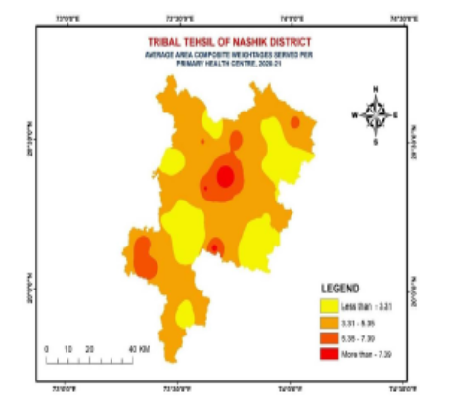
The hinterland of population depends on health service facilities. The area and people they can be used to gauge how effective they are? The primary goal of this article is to categorize PHCs into various service levels, as per average area served by per composite weightage on altitudinal belt-wise distribution of PHCs. Field survey, questionnaires; inspections of five rural hospitals and 38 PHCs are used for together data. GIS-based diagrams have been created for spatial evaluation and composite weightage are used to determine the average service area. The findings indicate that, primarily at higher elevations with poor accessibility, 34.88% of PHCs serve less than 3 square kilometers, 51.16% serve between 3 and 6 square kilometers and 13.95% cover more than 6 square kilometers. Five categories ranging from better served to very badly serviced, have identified through the classification of PHCs. PHCs are distributed unevenly, but significantly overall with the maximum concentration found in the 600–700 m altitudinal belt. The study has attention to regional differences in access to healthcare and offers suggestions for fair resource distribution of health planning in tribal areas.
Keywords: Health services, Composite Weightage, GIS, Tribal Area, PHCs
1. Borase, Suryawanshi DS, Kate AM (2014): GIS base mapping of Spatio-temporal distribution of healthcare services in Nasik district(M.S.)India. IJHEPS. 01(07) 2014, pp 52-57 www.ijheps.org
2. Christlar W. (1933): The central places of Southern Germany. Translated by C. W. Baskin, Prentice Hall.
3. Suryawanshi DS, Kate AM. Measuring the level of development of government healthcare facilities in tribal & non tribal region of Nasik district (M.S.) India. International journal of educational research and technology. 2015; 6 (4). Available from: https://doi.org/10.15515/ijert.09764089.6.4.3034
4. Garud SB, Suryawanshi DS. (2008) Status of Tribal Health Service Centers in Dhadgaon Tahsil of Nandurbar District, Shillong Hill Geographer. Vol-XXIV, No.1-2, and Pp 8589
5. Garud SB, Suryawanshi DS. Planning of Health Administration in Tribal Area: Present & Future. Journal of Research & Development. 08(03), 2018. pp.10-19. http://jrdrvb.com/
6. Wetal JD, Awhad AA, Suryawanshi DS, Suryawanshi MV. Spatial analysis of area influence of primary health centres in the tribal Tahsils of Nasik district. IJARIIT. 2022; 8 (3). Available from: www.ijariit.com
7. Wetal JD, Suryawanshi DS, Patil BS. (2021): Health Care Services in Tribal Tahsils of Nasik district. International Journal of Creative Research Thoughts (IJCRT). 9(7), 2021. www.ijcrt.org
8. Rai PK, Nathawat MS. Geoinformatics in Health Facility Analysis. 2017; Available from: https://link.springer.com/book/10.1007/978-3-319-44624-0
9. Rao SK. (1998). Health Care Services in Tribal Areas of Andhra Pradesh: A Public Policy Perspective. Economic and Political Weekly, 33(9). 481-486. https://www.jstor.org/stable/4406472
10. Singh SB. (1977): Distribution of centrality and hierarchy of rural central places in Sultanpur district of U.P., India, The National Geographical Journal, Vol. 23, Part 3-4, Page- 185-194.
11. Suryawanshi DS. (2007): Geography of Healthcare, Raj Publication, Jaipur.
12. Suryawanshi DS, Chaudhari SR. (2007): A study of healthcare services in tribal area of Western Satpura Region. Deccan Geographer. Vol-45 Pp 99-106
13. Suryawanshi DS, Garud SB (2013): Impact of relief on inequalities of infrastructure facilities in Dhadgaon tahsil of Nandurbar dist, (Maharashtra) India. Indian Stream Research Journal. Vol-6 Pp10-15 www.isrj.jet
© 2026 Suryawanshi. This is an open-access article distributed under the terms of the Creative Commons Attribution License, which permits unrestricted use, distribution, and reproduction in any medium, provided the original author and source are credited.
Published By Bangalore University, Bengaluru, Karnataka
Subscribe now for latest articles and news.