Geo-Eye
Department of Geography & GIS
Department of Geography & GIS
Geo-Eye
DOI: 10.53989/bu.ge.v14.i2.24.40
Year: 2025, Volume: 14, Issue: 2, Pages: 12-19
Original Article
T K Prasad1∗, P T Asim2, G Jayapal1, P Sruthi3, M Remith4
1Associate Professor, Department of Geography, Kannur University, Kerala, India
2Assistant Professor, Department of Geography, Kannur University, Kerala, India
3M Sc Geography, Department of Geography, Kannur University, Kerala, India
4Head, Kannur Kandal Project, WTI, Payyanur, Kannur, Kerala, India
∗Corresponding author
Email: [email protected]
Received Date:03 December 2024, Accepted Date:10 October 2025
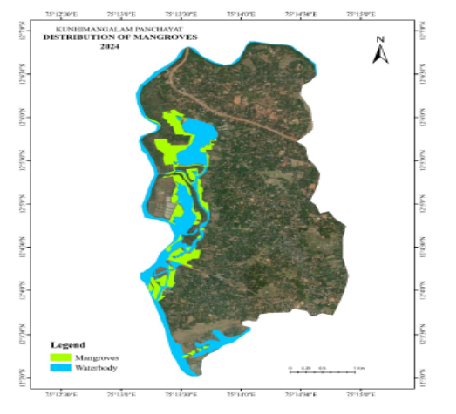
Mangroves are unique forest habitat that dominates tropical and subtropical coastlines around the world. True mangroves are exclusively found in the intertidal zones of beaches and are taxonomically distinct from their terrestrial equivalents. There are 54-75 species of true mangroves. Mangroves survive in highly salty waters and soils because they are well suited to their environment, capable of rejecting or expelling salt. Salinity, as well as other environmental conditions like climate, tidal fluctuation, silt, and wave energy, can still limit the range of mangroves. Mangrove vegetation's structural intricacies generate unique ecosystems that provide biological niches for a diverse range of creatures. Mangroves serve as breeding, feeding, and nursery grounds for most commercial fish and crustaceans, on which thousands of people rely for their livelihood. Mangroves are being destroyed and are facing serious threats as a result of urbanization, industrialization, and the discharge of domestic sewage, industrial effluents, and pesticides. Reclamation of wetlands for Coconut Plantations and conversion of mangroves for aquaculture are also a major threat to mangroves. Present study is enquiry on floral diversities of mangroves in Kunhimangalam region of Kannur in Kerala. The state and significance of their spatial distribution is also examined from a geographical stand point.
Keywords: Mangrove ecosystem, Floral diversity, Wet lands
© 2025 Prasad et al. This is an open-access article distributed under the terms of the Creative Commons Attribution License, which permits unrestricted use, distribution, and reproduction in any medium, provided the original author and source are credited.
Published By Bangalore University, Bengaluru, Karnataka
Subscribe now for latest articles and news.