Geo-Eye

Department of Geography & GIS

Article

Geo-Eye

Year: 2025, Volume: 14, Issue: 1, Pages: 21-28

Original Article

Causal Relationship of Occupational Health Issues: A Case Study of Solid Waste Management Workers in the South Zone of Coimbatore Corporation, Tamil Nadu, India

Received Date:16 November 2025, Accepted Date:10 October 2025

Abstract

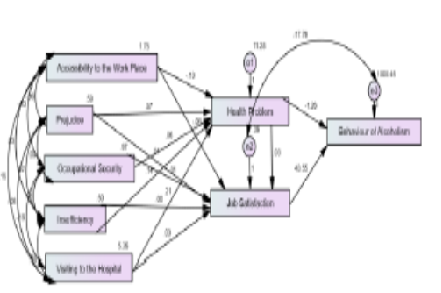
The objective of the study is to measure the causal relationship of occupational health issues of solid waste management workers working in the south zone of Coimbatore Corporation. The information was collected through the questionnaire schedule from the 300 sanitary workers working in the south zone of Coimbatore Corporation by stratified random sampling method. These variables are vital factors in determining the occupational status of sanitary workers in this study area. The results of the Structural Equation Model (SEM) of sanitary workers' data set suit the fit indices and the proposed hypothesis causal model relationships are acceptable fit by the recommended values. The structural equation model demonstrates that the variables namely behaviour of alcoholism, visiting the hospital, job satisfaction, accessibility to the workplace, health problems, public prejudice, occupational security and insufficiency of equipment are the occupational issues of sanitary workers in the study area. The scale used in this study adequately fits into the data collected and it concludes that the hypothesized thirteen assumptions model fits the collected sample data. As a result, the likelihood and statistical association of essential variables estimate, the good fit of the structural model and represent an adequate description of sanitary workers indicators support the model fit.

Keywords: Occupational Health, Solid Waste, SEM, Path Analysis

References

  1. Kaza S, Yao LC, Bhada-Tata P, Woerden FV. What a Waste 2.0: A Global Snapshot of Solid Waste Management to 2050. (pp. 115-140) Washington, DC. World Bank. 2018.
  2. Obeng-Odoom F. Enclosing the urban commons: Crises for the commons and commoners. Sustainable Cities and Society. 2018;40:648–656. Available from: https://doi.org/10.1016/j.scs.2018.01.001
  3. KJ, CV. Dumpsite rehabilitation. In: Lehmann EC., ed. Landfill Research Focus. (pp. 337-360) New York. Nova Science Publisher Inc. 2008.
  4. Sridevi V, Modi M, Lakshmi MVVC, Kesavarao L. A review on integrated solid waste management. International Journal of Engineering Science & Advanced Technology. 2012;2:1491–1499. Available from: https://www.scribd.com/document/527876783/10-1-1-300-9119
  5. Chavan D, Arya S, Kumar S. Open dumping of organic waste: Associated fire, environmental pollution and health hazards. In: CH, SH., eds. Hussain C and Hait S (eds) Advanced Organic Waste Management. (pp. 15-31) United Kingdom. Elsevier. 2022.
  6. Kumari S, Kiran UV. Prevalence of health problems of rag pickers due to various hazards at Lucknow city. Human Factors in Healthcare. 2022;2:100023. Available from: https://dx.doi.org/10.1016/j.hfh.2022.100023
  7. Yang H, Ma M, Thompson JR, Flower RJ. Waste management, informal recycling, environmental pollution and public health. Journal of Epidemiology and Community Health. 2018;72(3):237–243. Available from: https://dx.doi.org/10.1136/jech-2016-208597
  8. Kleinbaum D, Kupper L, Nizam A, Rosenberg E. Applied regression analysis and other multivariable methods (5). Boston MA. Cengage Learning. 2013.
  9. Gamborg M, Jensen GB, Sørensen TIA, Andersen PK. Dynamic Path Analysis in Life-Course Epidemiology. American Journal of Epidemiology. 2011;173(10):1131–1139. Available from: https://dx.doi.org/10.1093/aje/kwq502
  10. Bielderman A, Greef MHGd, Krijnen WP, Schans CPvd. Relationship between socioeconomic status and quality of life in older adults: a path analysis. Quality of Life Research. 2015;24(7):1697–1705. Available from: https://dx.doi.org/10.1007/s11136-014-0898-y
  11. Howe LD, Tilling K, Galobardes B, Lawlor DA. Loss to follow-up in cohort studies: bias in estimates of socio-economic inequalities. Epidemiology. 2013;24(1):1–9. Available from: https://doi.org/10.1097/ede.0b013e31827623b1
  12. Anderson JC, Gerbing DW. Structural equation modeling in practice: A review and recommended two-step approach. Psychological Bulletin. 1988;103(3):411–423. Available from: https://psycnet.apa.org/doi/10.1037/0033-2909.103.3.411
  13. Peter T. Adoption of Mobile money technology: Structural Equation Modelling Approach. European Journal of Business and Management. 2011;3(7):59–77. Available from: https://files.core.ac.uk/download/pdf/234624099.pdf
  14. Bagozzi RP, Yi Y. On the evaluation of structural equation models. Journal of the Academy of Marketing Science. 1988;16(1):74–94. Available from: https://doi.org/10.1007/BF02723327
  15. Barbara MB. Structural Equation Modelling with AMOS. Basic concepts, applications, and programming (2). (pp. 76-84) New York. Routledge, Taylor & Francis Group. 2009.
  16. DWG, JCA. Monte Carlo Evaluations of Goodness of Fit Indices for Structural Equation Models. Sociological Methods & Research. 1992;21(2):132–160. Available from: https://dx.doi.org/10.1177/0049124192021002002
  17. Hu L, Bentler PM. Cutoff criteria for fit indexes in covariance structure analysis: Conventional criteria versus new alternatives. Structural Equation Modeling: A Multidisciplinary Journal. 1999;6(1):1–55. Available from: https://dx.doi.org/10.1080/10705519909540118

Copyright

© 2025 Murali et al. This is an open-access article distributed under the terms of the Creative Commons Attribution License, which permits unrestricted use, distribution, and reproduction in any medium, provided the original author and source are credited.

Published By Bangalore University, Bengaluru, Karnataka

DON'T MISS OUT!

Subscribe now for latest articles and news.