Geo-Eye
Department of Geography & GIS
Department of Geography & GIS
Geo-Eye
DOI: 10.53989/bu.ge.v15.i1.25.3 3
Year: 2026, Volume: 15, Issue: 1, Pages: 1-8
Original Article
Melvin Manoj Abraham1, R Lakshmi1, Meharin Salim1, Hemika Asok1, Alfred Johny1*
1College of Climate Change and Environmental Science, Kerala Agricultural University, Thrissur, Kerala,India.
*Corresponding Author
Email: [email protected]
Received Date:15 December 2025, Accepted Date:22 February 2026
Coastal communities are increasingly vulnerable to natural disasters such as coastal erosion, cyclonic storms, tsunamis, and flooding. This study assesses the economic vulnerability and disaster preparedness of deprived coastal households in Veliyancode Panchayat, Malappuram district, Kerala. Using a vulnerability assessment framework, data was collected through field interactions across 18 wards to evaluate community awareness, evacuation preparedness, and government support. To address these challenges, the study adopts a top-down approach, linking socioeconomic vulnerability assessments from the district level to local self-governance and the community. The findings highlight critical gaps, with 37% of respondents unaware of evacuation sites, 64.6% lacking knowledge of swell surges, and 83.6% never participating in mock drills. Highly vulnerable zones were identified in Wards 1, 2, 15, 17, and 18, where exposure to coastal hazards is severe. While 72.5% of residents received disaster warnings, 27.5% did not, underscoring the need for improved communication systems. This research underscores the importance of targeted adaptation and mitigation strategies that improve resilience in coastal communities. Strengthening disaster preparedness through training programs, regular mock drills, and increased community awareness can significantly reduce disaster risks. The insights from this research contribute to policy recommendations that enhance disaster risk reduction efforts, ensuring that vulnerable coastal populations are better equipped to face future hazards.
Coastal environments occupy one of the most dynamic interfaces on earth, at the boundary between land and sea. These regions act as transition zones between terrestrial and marine systems and are often described as triple interfaces comprising land, sea, and atmosphere. According to WSSD (World Summit on Sustainable Development) reports[8], coastal areas cover approximately 20% of the Earth’s surface and support a significant proportion of the global population. Nearly 20% of the world’s population lives within 25 km of the coastline, while about 40% reside within 100 km[5]. Rapid development has been observed in coastal regions worldwide, with the number of coastal cities increasing from 472 in 1950 to 2129 in 2015[1]. Owing to their physical, social, and economic importance, these regions are under increasing pressure, making them highly vulnerable to issues such as coastal erosion, particularly in areas with high population density, tourism activities, developed economies, and low-lying terrain.
In response to these growing challenges, the concept of Integrated Coastal Zone Management (ICZM) has emerged as a key approach for balancing economic development with environmental protection in coastal regions[6]. ICZM provides a framework for the sustainable management of coastal resources. One of the widely accepted definitions, proposed by Cicin-Sain and Knecht (1998)[3], describes ICZM as “a continuous and dynamic process by which decisions are made for the sustainable use, development, and protection of coastal and marine areas and resources”[6]. Sustainable management, in this context, refers to the responsible use of goods and services generated by coastal ecosystems. Despite such frameworks, coastal zones continue to experience intense and sustained environmental pressures driven by both natural and anthropogenic factors.
Despite the adoption of management frameworks such as ICZM, coastal regions continue to face increasing environmental pressures and risks[7]. These challenges significantly enhance the vulnerability of coastal systems, particularly in tropical and subtropical regions. In recent decades, the frequency and intensity of climate-induced hazards have increased considerably, particularly in tropical and subtropical regions. These areas are particularly vulnerable due to climate change and natural hazards[7]. The impacts of these hazards vary across individuals and communities, making vulnerability a relative concept influenced by both environmental and socioeconomic conditions. This is evident in coastal regions experiencing sea level rise, flooding, and cyclones. In India, tropical cyclones pose a significant threat, as the country lies within one of the primary cyclogenesis zones[4]. Studies assessing highly exposed coastal regions often consider factors such as cyclone frequency, population density, coastline characteristics, and historical damage patterns[4].
These vulnerabilities often manifest in the form of disasters, is an unexpected and sudden event that leads to widespread destruction, loss of life, and significant disruptions to human populations, infrastructure, the economy, and the environment[5]. Due to its extensive impact, a comprehensive and multidimensional approach is essential to effectively mitigate and respond to its consequences. Disasters can be classified into two broad categories. The first category includes natural disasters, which arise from natural phenomena such as floods, tsunamis, earthquakes, landslides, hurricanes, and wildfires. These events occur due to environmental and geological factors beyond human control. The second category consists of manmade disasters, which result from human actions and include industrial accidents, terrorist attacks, epidemics, and other catastrophes stemming from human negligence, error, or deliberate actions[5].
In the context of Kerala, coastal areas are highly prone to such natural hazards due to their geographical location along the Arabian Sea. Storm surges and flooding during the monsoon season causes significant damages to coastal areas like coastal erosion and land loss, which will affect the infrastructure, habitats, and livelihoods. Coastal erosion has become a critical issue because population concentration is high in coastal areas with many development activities, such as industrial activities and increased transportation and tourism activities[1]. Globally, approximately 30% of residences in 200 m-long low coasts have been estimated to be highly affected by erosion, resulting in losses to properties in the next 50 years[1]. It is very crucial to implement effective strategies or policies for mitigation and adaptation to ensure the resilience and safety of Kerala's coastal communities[2].
Several studies have attempted to assess coastal vulnerability using different methodological approaches. For instance, Anakha et al. (2024)[2] examined the socioeconomic vulnerability of coastal settlements in Kerala using Analytical Hierarchy Process (AHP) and Geographic Information System (GIS) techniques. Their study employed the Coastal Vulnerability Index (CVI), which integrates both the Physical Vulnerability Index (PVI) and Social Vulnerability Index (SVI) to evaluate factors such as poverty, unemployment, educational attainment, and other socioeconomic characteristics[6].
Similarly, Rani et al., 2015[7] conducted previous research on coastal vulnerability along the Indian coast has utilized a variety of approaches, including index-based methods, indicator-based frameworks, GIS-based decision support systems, and dynamic modeling techniques. While these studies provide valuable insights into spatial and physical aspects of vulnerability, many of them rely on limited datasets and predominantly emphasize biophysical parameters. There is comparatively less focus on community-level disaster preparedness, awareness, and access to early warning systems, particularly at the local (panchayat) scale.
Moreover, very few studies have integrated socioeconomic vulnerability with disaster preparedness at the household level in coastal regions of Kerala. This highlights a critical research gap in understanding how local communities perceive, prepare for, and respond to disaster risks. The objective of this study is to examine the impacts of natural disasters on coastal communities and evaluate the level of community awareness, evacuation preparedness, and government support provided to people living in disaster-affected regions. The vulnerability assessment is based on primary data collected through field interactions across the selected wards of the panchayat.
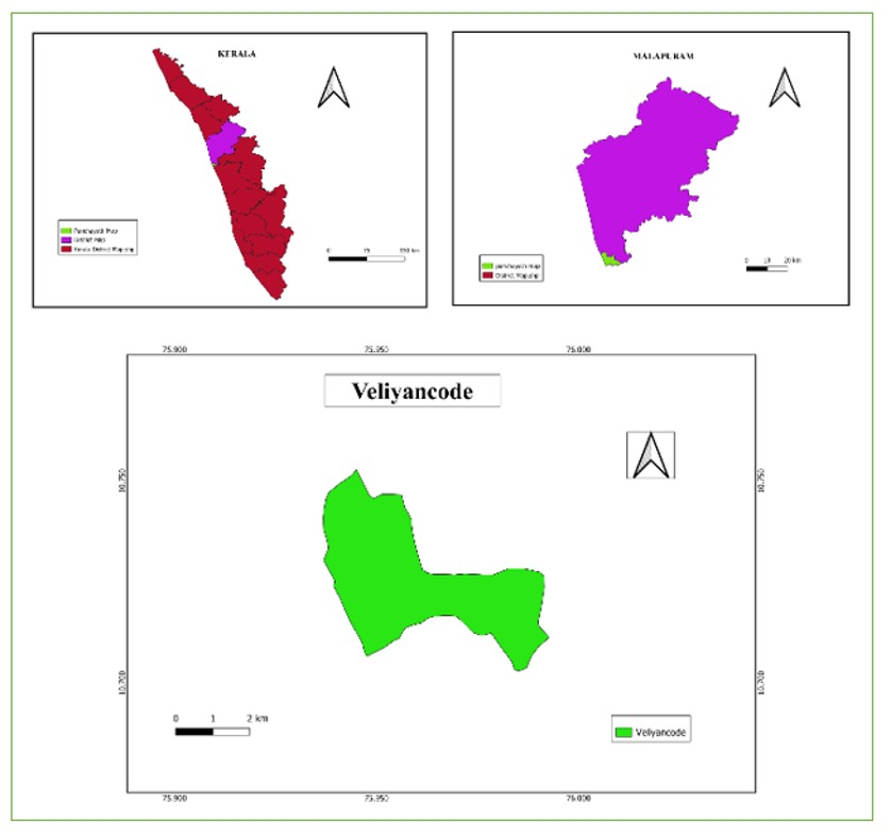
The study was conducted in Veliyancode Grama Panchayat, located in Ponnani Taluk of Malappuram district in the state of Kerala, India. The panchayat lies along the Arabian Sea and is geographically positioned between 10.729600° N latitude and 75.947140° E longitude. It covers a total area of approximately 1521 hectares and comprises 18 administrative wards [Fig. 1]. According to the 2011 Census, the total population of the area is about 32,554, including approximately 15,054 males and 17,500 females.
The survey was conducted in selected wards of the panchayat, namely Wards 1, 2, 15, 17, and 18, which were purposively chosen due to their high exposure to coastal hazards. Factors such as high population density, low nearshore bed slope, low coastal elevation, high erosion rates, and the proximity of built-up areas and infrastructure to the coastline contribute significantly to the vulnerability of these areas.
Veliyancode was selected for this study due to its high susceptibility to multiple natural hazards. Its proximity to the Arabian Sea makes it particularly vulnerable to coastal erosion, cyclonic storms, sea-level rise, and tidal surges. In addition, the region frequently experiences monsoon-induced flooding, which disrupts local infrastructure and livelihoods.
The local economy is predominantly dependent on climate-sensitive sectors such as fishing and agriculture, both of which are highly affected by extreme weather events. Furthermore, several social factors—including limited access to healthcare, scarcity of freshwater resources, educational disparities, the presence of women-headed households, migration issues, employment instability, and economically weaker sections—further increase the vulnerability of the population. These combined environmental and socioeconomic factors make Veliyancode a critical case for assessing coastal vulnerability in the context of ongoing climate change.
The local economy is predominantly dependent on climate-sensitive sectors such as fishing and agriculture, both of which are highly affected by extreme weather events. Furthermore, several social factors—including limited access to healthcare, scarcity of freshwater resources, educational disparities, the presence of women-headed households, migration issues, employment instability, and economically weaker sections—further increase the vulnerability of the population. These combined environmental and socioeconomic factors make Veliyancode a critical case for assessing coastal vulnerability in the context of ongoing climate change.
Primary data were collected from all 18 wards of the Veliyancode coastal panchayat. A structured questionnaire was used to assess respondents’ knowledge of evacuation measures and location-specific actions to be taken during emergencies or disasters. Responses were collected through in-person surveys using Google Forms, enabling efficient data collection and ensuring representation across diverse socioeconomic groups. The questionnaire focused on past experiences with tsunamis and other coastal hazards, awareness of disaster risks and early warning systems, socioeconomic characteristics, dependence on coastal resources for livelihoods, evacuation planning, and community participation. Data were collected from households across all 18 wards.
In addition to the survey, first-hand information was obtained through interactions with local residents. Focus group discussions were conducted with key community groups to understand collective perspectives and incorporate local knowledge. Participatory mapping exercises were also carried out, through which community members identified high-risk areas and evacuation routes.
The collected information was combined to produce the findings that identified the qualitative and quantitative objectives of the coastal communities of Veliyancode Panchayat. A number of crucial areas of concern were found by this analysis. Their reliance on climate-sensitive jobs like fisheries and agriculture makes them more vulnerable to natural disasters. As many of them are not economically stable, it also makes them limit the access of resources. This highlights the socioeconomic vulnerability of the area, where livelihoods could be severely impacted by severe weather or disturbances in marine ecosystems.
The survey provides vital data regarding disaster experiences, preparedness levels, and access to early warning systems. Veliyancode, being a coastal panchayat, is highly vulnerable to natural hazards such as coastal flooding, storm surges, and tsunamis. The area was notably affected by the 2004 Tsunami, and recurrent monsoonal flooding continues to pose a threat to the local population and infrastructure.
One of the key components of the survey was an assessment of disaster impact experienced by the community. Among the participated households, 50.8% reported loss of livelihood or employment—mainly linked to agriculture and other community-based occupations—emerging as the most affected sector. 45.2% of households reported damage to property, highlighting the vulnerability of local infrastructure and residential buildings. Furthermore, 26.5% experienced loss of domestic animals or crop damage, revealing the impact of disasters on food security and agricultural sustainability. Health-related consequences, including both physical ailments and mental stress, were cited by 17.2%, pointing to the often-neglected aspect of post-disaster healthcare and psychosocial support. Notably, 2.2% reported casualties or the death of family members, reflecting the fatal risks associated with high-impact disasters in the region.
Although 62.6% of respondents reported being aware of natural disasters common to coastal regions—such as cyclones, tsunamis, and storm surges—a significant portion of the population remains inadequately informed, pointing to a concerning gap in disaster awareness. This lack of knowledge may hinder timely and appropriate responses, particularly in the absence of strong community-based preparedness systems. In addition to examining awareness levels, the survey also assessed access to early warning systems. While 62.3% of respondents stated they usually receive advance alerts about natural disasters in the coastal area, 37.7% reported not receiving timely disaster-related information. In terms of basic knowledge about warnings [Table. 1], 71% of respondents were aware of colour-coded rainfall warnings, but only 29.4% knew about tsunami warning codes. Just 19.9% had received any training on how to respond to coastal disasters like tsunamis, storm surges, or cyclones. Awareness of the swell surge phenomenon stood at 35.4%, indicating an overall need to improve understanding of warning systems and response strategies. This communication gap poses a serious obstacle to effective disaster response and highlights the urgent need to improve the reach and reliability of early warning dissemination—especially in marginalized or geographically isolated parts of the panchayat.
Additionally, the survey explored community awareness of evacuation procedures and basic first aid. Questions related to evacuation procedures and local emergency preparedness [Table. 2] revealed varying levels of awareness among residents. While 63% of the respondents were aware of the nearest relief camp or assembly point, only 53.4% knew the routes to reach safer locations during emergencies. A smaller segment, 11%, had undergone a coastal evacuation, and just 16.4% mentioned that mock evacuation drills had ever taken place in their ward. Additionally, 10% of participants noted facing difficulties during evacuation, and only 21.1% had received any kind of formal training or instruction on handling coastal disasters. These gaps underscore the urgent need to strengthen community preparedness through focused awareness initiatives and regular mock drills in every ward. When asked about their awareness of disaster risk indications, precautionary measures, and appropriate actions to take during a disaster, only 50% of the respondents reported being informed. This indicates a considerable gap in fundamental disaster literacy, which could hinder effective response during emergencies. However, a more encouraging finding was that 70% of participants had the contact information of first responders readily available, suggesting a relatively good level of practical readiness in terms of emergency communication. These results highlight the importance of strengthening educational outreach to improve understanding of disaster risks and promote comprehensive preparedness at the household level. Knowledge of first aid during disasters was generally limited: only 8.3% of respondents reported being well aware, and 46.8% were somewhat aware, while 38.7% had minimal knowledge and 6.2% reported none at all. Moreover, only 23.3% of households had prepared and maintained a first aid kit. Encouragingly, 76.6% of respondents expressed interest in attending awareness classes on coastal disasters, highlighting a strong demand for community-based training.
The survey also incorporated questions related to climate change, focusing on its perceived impacts on the environment and daily life. When asked about environmental effects [Table. 3], the most common response was a rise in atmospheric temperature (43.4%), followed by prolonged droughts, floods, and disasters (22.4%), and sea level rise (19%). Meanwhile, 9.5% observed no noticeable changes, and 35.6% stated they did not know the impacts. A smaller portion (5.7%) mentioned other effects, highlighting the varied levels of understanding within the community (Table 4.3). Concerning daily life impacts, 30.1% of respondents noted health issues, making it the most commonly experienced consequence. Lifestyle disruptions and difficulties in adapting were noted by 14.9%, while 4.6% observed changes in agricultural field conditions, indicating emerging challenges in local food systems. Notably, 33% of respondents stated that they had not observed any noticeable changes in their daily lives, and 27.5% expressed uncertainty or a lack of awareness regarding the effects of climate change. These findings suggest a varied perception of climate change impacts at the community level and underscore the need for improved climate communication and education to enhance public understanding and adaptive capacity.
|
Sl. no |
Questions |
Responses |
|---|---|---|
|
1. |
Do you know colour coded rainfall warnings? |
71% |
|
2. |
Do you know about colour coded tsunami warnings? |
29.4% |
|
3. |
Have you got any prior training on how to respond to tsunami or storm surge or cyclone? |
19.9% |
|
4. |
Do you know about the phenomenon of swell surge? |
35.4% |
| Sl. no | Questions | Responses |
|---|---|---|
| 1. | Do you know the nearest relief camp/assembly point? | 63% |
| 2. | Do you know the routes to reach a safe location during emergencies? | 53.4% |
| 3. | Have you faced any specific challenges in evacuating from this coastal area during an emergency? | 10% |
| 4. | Have you ever experienced a coastal evacuation? | 11% |
| 5. | Has a mock drill related to evacuation been conducted in this ward? | 16.4% |
| 6. | Have you received any classes or training related to coastal disasters? | 21.1% |
| 1. What do you think are the impacts of climate change? | |
|---|---|
| Rise in atmospheric temperature | 43.4% |
| Prolonged droughts and floods/disasters | 22.4% |
| Sea level rise | 19% |
| No changes observed | 9.5% |
| Don’t know | 35.6% |
| Others | 5.7% |
The findings of this study reveal significant gaps in disaster preparedness, awareness, and climate change perception within the coastal community of Veliyancode. Despite the region’s history of recurrent natural hazards such as tsunamis, storm surges, and monsoonal flooding, the community remains highly vulnerable. This vulnerability is reflected in frequent experiences of livelihood disruption, property damage, and agricultural losses—particularly among households reliant on climate-sensitive and resource-dependent occupations. Health-related impacts, including both physical ailments and psychological stress, further underscore the need for integrated post-disaster care and long-term support systems that address both immediate and residual effects of disasters.
While a segment of the population displays some understanding of common coastal hazards, overall disaster literacy remains moderate. A considerable portion of residents lack adequate knowledge of risk indicators, warning codes, and appropriate response measures. Access to early warning systems is inconsistent—some individuals receive alerts but are unable to interpret them effectively, particularly for lesser-known events like swell surges or tsunami warnings. Household-level preparedness remains low, as evidenced by the limited number of homes equipped with emergency kits or informed about evacuation procedures. Moreover, participation in formal training programs or evacuation drills is minimal. Despite these gaps, community interest in improving preparedness is strong, with many respondents expressing willingness to attend training or awareness sessions.
However, practical challenges limit engagement. Many women indicated that domestic responsibilities prevent them from attending awareness sessions or evacuation drills, while men cited the inflexibility of daily wage labour that often precludes taking time off for non-income-generating activities. These socioeconomic and time constraints form substantial barriers to participation, even where awareness and motivation exist. This highlights the need for inclusive and flexible engagement strategies—such as scheduling activities during off-peak hours, organizing mobile awareness units, and embedding disaster preparedness education within existing community and cultural gatherings.
Perceptions of climate change within the community are uneven. While many respondents reported experiencing environmental changes like rising temperatures, irregular rainfall, and increased health problems, a sizable number expressed uncertainty or a lack of awareness regarding climate change and its impacts. This discrepancy suggests an ongoing communication gap between scientific discourse and local understanding. Without tailored and accessible communication strategies that link global climate narratives to local realities, the community’s ability to adapt and build resilience remains constrained.
Improving disaster and climate resilience in such coastal regions requires a multi-tiered, context-sensitive approach. At the community level, disaster risk education must be prioritized through targeted campaigns, school-based learning, and participatory public outreach. Regular ward-level evacuation drills coordinated with local authorities can enhance readiness, while the establishment of community emergency committees—with basic training in first aid, evacuation, and crisis communication—can decentralize and strengthen response mechanisms. Household preparedness should be actively promoted through local campaigns, encouraging the adoption of emergency kits and family safety plans. Local institutions such as women’s groups, youth clubs, and religious organizations should be leveraged to expand the reach and relevance of these efforts.
At the governmental level, it is essential to strengthen early warning dissemination systems using diversified and demographically accessible channels such as SMS alerts, mobile applications, public address systems, and community notice boards. These systems must be designed to reach marginalized and technologically underserved groups. Disaster risk reduction should be mainstreamed into local governance structures and development planning, ensuring that resilience-building efforts receive sustained institutional and budgetary support. Government agencies must also invest in capacity building for frontline personnel—including local officials, educators, and healthcare workers—to enhance grassroots response capabilities. Climate change communication must be improved through the development of culturally and linguistically appropriate materials that make abstract concepts relatable and actionable at the local level.
Livelihood diversification is another crucial component, particularly in a setting where economic activities are closely tied to natural resources and seasonal variability. Providing financial and technical support for alternative income sources can reduce exposure to climate-sensitive risks and enhance long-term resilience. Equally important is ensuring inclusive participation in all disaster preparedness and adaptation planning processes. Women, the elderly, persons with disabilities, and marginalized communities must be meaningfully involved in decision-making to ensure that policies and programs are equitable and responsive to diverse needs.
Finally, strengthening communication strategies that contextualize climate science in ways that resonate with lived experiences can bridge existing knowledge gaps and foster behavioral change. By linking immediate disaster preparedness with long-term climate adaptation, and by supporting both institutional reforms and community-driven initiatives, a more informed, resilient, and adaptive coastal population can be cultivated—one that is better equipped to respond proactively to both sudden disasters and gradual environmental transformations.
This study focused on the socio-economic vulnerabilities and disaster resilience of the coastal regions of Veliyancode Panchayat, revealing both strengths and significant gaps in community preparedness. The survey highlights that while certain wards have developed considerable resilience due to repeated exposure to natural disasters such as tsunamis, cyclones, and coastal flooding, many regions remain highly vulnerable—particularly those with limited access to early warning systems, inadequate disaster literacy, and fragile livelihood systems. Proximity to the sea and exposure to tidal fluctuations increase the risk of flood-like conditions, underscoring the urgent need for localized, context-aware risk reduction strategies.
One of the major concerns highlighted by the study is the fragility of local infrastructure and the widespread livelihood insecurity faced by household’s dependent on agriculture, fishing, and daily wage labour. Damage to property, crops, and domestic animals, as well as disruptions in income, emerged as significant consequences of disasters. Health impacts—both physical and psychological—further compounded the stress on affected families, underscoring the need for integrated disaster recovery and psychosocial support systems. Importantly, while 76% of respondents expressed willingness to attend awareness sessions, real-world participation was often hindered by socio-economic realities. Many women cited household duties, and men noted the inflexibility of daily wage labour, as barriers to attending training sessions or drills. These factors emphasize that disaster education and engagement strategies must be designed to fit the lived realities of the community. Outreach should be flexible, locally embedded, and involve trusted institutions and community leaders.
Ensuring inclusive participation in disaster and climate adaptation planning—particularly from women, the elderly, marginalized groups, and persons with disabilities—is fundamental to creating a comprehensive and equitable resilience strategy. Additionally, there is a strong need for improved climate education initiatives that present scientific information in relatable, practical formats, empowering the community to understand and respond to long-term environmental change. Addressing these interconnected issues requires coordinated action at both community and government levels.
By implementing these measures at both the community and government levels, Veliyancode Panchayat can build a more informed, empowered, and resilient population—capable of not only responding effectively to natural disasters but also adapting to the slow-onset impacts of climate change. A multi-pronged, inclusive, and community-sensitive approach—combining education, governance reform, infrastructural investment, and social mobilization—can help build a more informed and resilient coastal society capable of withstanding both immediate disasters and the gradual impacts of climate change.
Acknowledgements: Authors would like to thank Dr. Sekhar L Kuriakose and team from Kerala State Disaster Management Authority (KSDMA) for the funding. Also, would like to thank Dr. P O Nameer, Dean, College of Climate Change and Environmental Science (CCCES), Kerala Agricultural University (KAU), Thrissur for the support. Thanks to District Disaster Management authority (DDMA), Malappuram and Veliyancode Gramapanchayath for their support for smooth implementation of study.
Author contribution: All authors contributed to the study conception and design. Concept and methodology development by Alfred Johny. Material preparation, data collection and analysis were performed by Melvin Manoj Abraham, Lakshmi R, Meharin Salim, Hemika Asok. The first draft of the manuscript was written by Melvin Manoj Abraham and all authors commented on previous versions of the manuscript. All authors read and approved the final manuscript.
Funding: The project and work was funded by Kerala State Disaster Management Authority (KSDMA), Thiruvananthapuram, Kerala.
Financial interests: The authors declare they have no financial interests.
1. Anakha K, Mathew JB. (2024). Study focuses on the socio-economic vulnerability of coastal settlements in the context of Kerala. International Journal of Advances in Engineering and Management (IJAEM), 6(5), 177–182.
2. Cicin-Sain B, Knecht RW. (1998) Integrated Coastal and Ocean Management: Concepts and Practices. Island Press, Washington DC
3. The role of natural ecosystems and socio-economic factors in the vulnerability of coastal villages to cyclone and storm surge. Natural Hazards. 2012; 64 (1). Available from: https://doi.org/10.1007/s11069-012-0255-9
4. A systematic review of socio-economic assessments in support of coastal zone management (1992–2011). Journal of Environmental Management. 2015; 149 Available from: https://doi.org/10.1016/j.jenvman.2014.10.018
5. Coastal vulnerability assessment studies over India: a review. Natural Hazards. 2015; 77 (1). Available from: https://doi.org/10.1007/s11069-015-1597-x
6. Report of the World Summit on Sustainable Development (2002), Johannesburg, South Africa, 26 August-4 September 2002. A/CONF.199/20
7. Process analysis in the coastal zone of Bénin through remote sensing and socio-economic surveys. Ocean & Coastal Management. 2012; 67 Available from: https://doi.org/10.1016/j.ocecoaman.2012.06.005
8. Integrating natural and socio-economic science in coastal management. Journal of Marine Systems. 2000; 25 (3-4). Available from: https://doi.org/10.1016/s0924-7963(00)00033-6
© 2026 Abraham et al. This is an open-access article distributed under the terms of the Creative Commons Attribution License, which permits unrestricted use, distribution, and reproduction in any medium, provided the original author and source are credited.
Published By Bangalore University, Bengaluru, Karnataka
Subscribe now for latest articles and news.